403 ERROR
The Amazon CloudFront distribution is configured to block access from your country. We can’t connect to the server for this app or website at this time. There might be too much traffic or a configuration error. Try again later, or contact the app or website owner.
If you provide content to customers through CloudFront, you can find steps to troubleshoot and help prevent this error by reviewing the CloudFront documentation.
Generated by cloudfront (CloudFront) Request ID: JQpCT3JtSo61ots17FPAwHVOyKMpAmUT2xljZg7dCs6qKGlke5wTwg==
Ford F-250: Ford V-10 Specs and Information
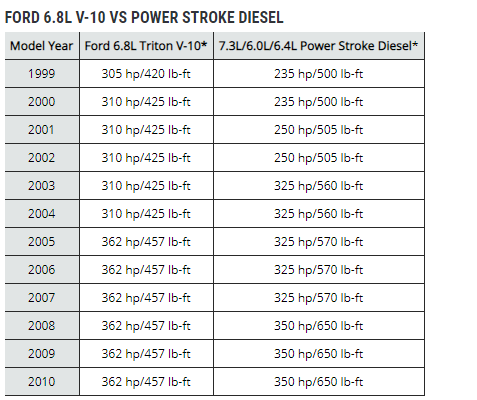
The 6.8-liter V10 Triton is a proud member of the Modular engine group since it shared an identical cylinder bore and stroke with the 5.4-liter V8. The V10 is out there to give consumers a gasoline option if they aren’t interested in the Power Stroke diesel powerplant. In 2005, Ford introduced the V10 as a replacement to the long-running 7.5-liter V8 in the Super Duty. The Triton V10 was a SOHC 20-valve engine that produced 310 horsepower and 425 lb-ft of torque. That same year, the V10 would also get 3-valve cylinder heads that increased the output to 362 horsepower and 457 lb-ft of torque.
First generation 1999-2007
Second generation 2008-2010
The 3-valve 6,802 cc V10 SOHC was still a $700 option over the 6.8-liter V8 and is a carryover from the last gen.

Related Discussions
- F-250: Specifications by Trim- FordTrucks.com
- F-250: Recalls and Bulletins — FordTrucks.com
- F-250: Common Problems — FordTrucks.com
Related Articles
7 Ford Truck Concepts
Which Ford Truck Does the Best Burnouts?
Top 5 Most Reliable Ford Truck Engines
9 Most Badass Ford Truck Engines of the Past 50 years
Ford F-250: 2019 Super Duty Specs and Information
Daily Slideshow: The Raptor’s Coolest Features
Related Articles
7 Ford Truck Concepts
Which Ford Truck Does the Best Burnouts?
Top 5 Most Reliable Ford Truck Engines
9 Most Badass Ford Truck Engines of the Past 50 years
Ford F-250: 2019 Super Duty Specs and Information
Daily Slideshow: The Raptor’s Coolest Features
F-150 How-Tos
- General Overview
- 4WD — Four Wheel Drive
- Brakes
- Cleaning and Detailing
- Exterior
- Interior
- Off-Roading
- Powertrain
- Steering and Suspension
- Towing and Hauling
- Transmission
- Wheels and Tires
Participate In The Forums
Create new posts and participate in discussions. It’s free!
Sign Up »
- Advertising
- |
- Contact Us
- |
- Cookie Policy
- |
- Privacy Statement
- |
- Terms of Service
- |
- Do Not Sell or Share My Personal Information
- |
- About Us
- |
- Manage Preferences
© 2023 MH Sub I, LLC dba Internet Brands
When you click on links to various merchants on this site and make a purchase, this can result in this site earning a commission. Affiliate programs and affiliations include, but are not limited to, the eBay Partner Network.
How is the 2003 Ford F250 V10 6.8L engine and transmission?
I gave up trying to find a Ford F250 1999 to 2003 7.3L diesel for under $25K so am now looking at the F250 with the gas 6.8L V10 engines. A gently used 2003 truck with 110K miles popped up for sale for $8K. The owner is the second owner and is a contractor who bought the truck about 7 years ago along with two other diesel trucks. He ended up using his diesel trucks instead due to better gas mileage so hasn’t used the truck much and decided to sell it. It is in great shape inside and out. The transmission is the original transmission, tires and brakes are in good shape and he has all the maintenance records and has been good about maintaining the truck. I need a truck for my 2,700 lb Lance cabover camper which is currently sitting on a 1990 regular cab F250 with a 7.5L gas engine. This truck has been fantastic except that I need an extended cab for children and dogs.
Is there anything I should know about the V10 engines other than they are gas hogs. I am intimately familiar with gas hogs. When traveling in our current rig we cannot pass a gas station without stopping. Our 30 gallon tank gets us about 200 miles before we need to fill er up. Unfortunately, the 2003 v10 versions have 30 gallon tanks, too. Ah for an extra 10 gallons but hey beggars can’t be choosers!
Any advice would be welcome. Thanks!
maddyforford
01-16-2017, 01:34 AM
Senior User
Join Date: Sep 2014
Location: Ventura, Ca
Received 0 Likes on 0 Posts
make sure you properly torque the spark plugs if you change them. otherwise you’ll end up launching one taking out the coil and stripping the threads in the head. check out the 5 star tuning for a tuner with some custom tunes for towing, performance and economy.
there were a couple companies offering 50 gallon replacement gas tanks a few years ago but the epa passed some new bull**** so they are not available anymore. I missed it my 3 mos, so pissed. my 2000 v10 has about 190k and is still going strong. maintain it and it’ll keep running. cheers
darkjedi351
01-16-2017, 08:03 AM
World Famous Mod

Join Date: Jul 2010
Location: Media PA
Posts: 11,051
Received 639 Likes on 454 Posts
In many circles the 2V V-10 and the 4R100 transmission are both looked down upon as being «inferior». Many of these comments and discussions wind up making comparisons to newer engines and transmissions. Imagine that, newer, more modern and expensive equipment actually performs better than older, cheaper stuff!
The 2V V-10 is a super reliable and capable engine, and at 110k miles it still has plenty of life left in it. The Common issues with these engines are broken exhaust manifold studs (a good excuse to install headers!) and the above mentioned spark plus ejections. During the ’03 model year Ford increased the number of threads in the spark plug holes to address the issue of plugs ejecting on the earlier 4 thread heads. So that ’03 may have either style depending on production dates. But following proper procedures when installing new plugs should cover you and deliver reliable service.
The 4R100 transmission is also very durable if properly cared for. While not as awesome as the more modern transmission with more gears and features it will hold up and get the job done if not abused. Be sure to do a complete fluid flush every 30k miles and monitor the temperature when hauling or towing and it should last many more miles. If your use and ambient temps have it running on the hotter side, upgrading to the larger, more efficient 6.0 trans cooler is an easy and effective mod.
These V-10s make their best power up higher in the RPM range, so running deeper gears like 4.30 or 4.56 will deliver improved much better towing/hauling performance over the standard 3.73 gears. The 4.30 was a factory option, so check to see what gears this truck has.
It sounds like you are currently seeing maybe 7/8 MPG with your ’90 7.5 F-250, with the right setup I would expect a decent improvement over that with the «gas hog» V-10. With my 2V V-10 4R100 3.73 Excursion we were towing a 31′ 9,500lb toyhauler and seeing 6/7 MPG on trips up/down the East coast. With a swap to deeper 4.88 gears the towing mileage increased to 9 MPG with the same weight over the same route and speeds. Currently that same EX has a 4″ lift, 35″ tires which give an effective ratio of 4.39 with the 4.88s, headers, Aeroturbine 3030XL muffler and 5Star Tuning’s custom tunes. We are now towing a 41′ 11,000lb TT and typically see from 8 to 9.4 MPG on our mostly highway trips.
If you get the new truck, go through it and change/flush ALL the fluids and give it new plugs and boots if they were not done at the scheduled 100k interval. Good luck!
Rebuilding the Ford Triton V10 Engine
It looks as though for 2017, Ford is going to be bringing back the 6.8-liter Triton V10. There has been a lot of advertisement through the media on the matter and it seems everyone thought the V10 no longer existed. To everyone’s surprise, the V10 actually never stopped production. Many thought that when Ford quit offering the engine as an option for the 2011 Superduty that the Triton was no longer available. However, the V10 has been offered as an option for the F450-F750 cab and chassis along with motorhome chassis since 2012. With the introduction of the 6.2-liter V8, the V10 was dropped from the Superduty line.
Related Articles
- — Shop Solutions December 2023
- — The Impact of Fuel Type on Engine Performance
- — Component Cleanliness
The V10 has been an option for the Ford truck chassis since 1997. With the elimination of the 385 series 460 cubic inch big block, Ford offered the V10 as a diesel alternative. The V10 is a part of Ford’s modular family, and is actually identical to the 5.4-liter SOHC with a 3.552˝ bore and 4.165˝ stroke with the addition of two cylinders.
The two-valve version, which produced 310 horsepower and 425 ft.-lbs. of torque, was offered from 1997 through 2004 models. The three-valve version was offered from model year 2005 through present vehicles with 360 horsepower and 457 ft.-lbs. of torque. The crankshaft is unique with a split pin for 72° firing intervals with a firing order of 1-6-5-10-2-7-3-8-4-9 and a balance shaft placed in the driver’s side cylinder head to help in dampening vibrations.
The V10 has offered great service and reliability with a life expectancy of 300,000 miles plus. These engines are reasonable to rebuild with a variety of aftermarket parts available for them. This is a great opportunity to examine the components that make up the biggest modular engine along with the changes the engine underwent during production.
One thing to keep in mind would be the initials “PI” cast into the cylinder heads. These initials stand for “Performance Improvement.” Early versions of this engine from 1997 until 1999 were considered “Non-PI.” The “PI” versions started in 2000, and incorporated changes to the cylinder head and intake manifold, which resulted in significant power gains for the engine. The intake manifold and cylinder heads of “PI” will not interchange with “Non-PI” due to differences in port design.
Below is a list of changes of the engine components in relation to the casting number. Many engine remanufacturers refer to the casting number for proper fitment of engine parts. The actual part number of each component is difficult to trace because many of the component part numbers were superseded many times during production.
Casting Number: F7VE – produced from 1997 until 1999 and known as “Non-PI” version. Has rounded intake ports with an open style combustion chamber with one intake valve and one exhaust valve.
YC2E – produced from 2000 until 2001 and known as “PI” version. Has somewhat of a square shaped intake port with more of a closed style combustion chamber which offered a small compression ratio change. Also has one intake valve and one exhaust valve.
1C2E – produced from 2002 until 2004 and known as “PI” version. Same head as the YC2E with differences being to the spark plug threads.
These heads had revisions to the spark plug threads because Ford had issues with the Modular engines (meaning the 4.6 liter and 5.4 liter) prior to this that would blow the spark plugs out. The problem was that there were not enough threads holding the spark plugs in the cylinder heads. Over a period of time the spark plugs would work loose and then blow out, stripping the threads from the cylinder head. There is a service tool and procedure for the prior cylinder heads which will ream the stripped spark plug hole to allow for a new threaded insert for the spark plug.
The 1C2E cylinder head is often referred to as “LP,” meaning long plug.
5C3E – produced from 2005 until 2007, this was the introduction of the three-valve version. This head had two intake valves and one exhaust valve. The spark plugs changed to a different design for the three-valve combustion chamber. The intake ports are an oval shape for the split port design of the two intake valves.
9C3E – produced from 2008 until present and are very similar to the 5C3E except for a smaller combustion chamber which resulted in a small compression change.
From 1997 until 2005 the two-valve version cylinder heads used a spark plug with a 14mm thread, an 18 mm reach, and a 5/8˝ hex. The valve diameters were 44.5 mm intake valve and a 36 mm exhaust valve.
From 2005 until present the three valve version cylinder heads used a spark plug with a 12mm thread, 26.5 mm reach, and a 9/16˝ hex. The valve diameters were 34 mm for the two intake valves and 37.5 mm for the one exhaust vale.
Note – Head bolts are torque-to-yield (TTY) meaning a one-time use. The two-valve and three-valve versions require different part numbers for replacement head bolts.
Casting Numbers: F7UE – available from 1997 until 2001, was produced for “Non-PI” engines
1C3E – in production from 2001 until 2003, was produced for “PI” ,cylinder heads and had knock sensor bosses in the engine valley. Keep in mind that you may find that some blocks will have the knock sensor bosses machined and some will not be machined.
3C3E – production from 2003 until 2005, was produced for the “PI” cylinder heads and should have machined knock sensor bosses in the valley of the engine.
5C3E – production from 2005 until present, was produced for the use with the three-valve version cylinder heads and intake. Very similar to the 1C3E and 3C3E engine blocks.
The 5C3E (latest version) block will work for a replacement of all previous production blocks as long as it is used with “PI” cylinder heads. The “PI” cylinder heads used a “PI” intake which has a shallow plenum versus the “Non-PI” intakes which had a deeper plenum. The “Non-PI” heads cannot be used with latest version block because the deep plenum of the intake will hit the knock sensor bosses in the valley of the engine.
Note – There are various types of intakes for these engines based on their applications. Some intakes were aluminum and some were plastic. There are differences in designs used between truck and van applications. The important thing to remember is there is not only a difference in port designs for “Non-PI,” “PI” and three-valve but also the depth of the plenum.
F7UE – production from 1997 until present. The crankshaft is a 4.165˝ stroke with a 72° split pin rod journal meaning that each rod journal is offset to fire at 72° intervals. Because of the split pin design the crankshaft is performance limited.
Pistons were the same design for Non-PI and PI two-valve per cylinder versions. There was a design change for the three-valve per cylinder version, which was the same from 2005 until present.
The connecting rods were the same material and length for all production years. The connecting rod material is a sintered powder metal with floating wrist pins and 6.658˝ long. This length of connecting rod with a 4.165˝ stroke crankshaft yielded a nice 1.60:1 rod to stroke ratio.
Chains and Tensioners
The timing chains and tensioners were the same for all years of production.
Camshafts and
Balance Shaft
Non–PI engines produced from 1997 until 1999 take a different camshaft from the PI versions produced from 2000 until 2005. The three valve per cylinder versions produced from 2005 until present also required a different camshaft. Keep in mind that when purchasing a new camshaft identify which version you have and remember that there is separate part numbers for the left bank and right bank camshaft.
Balance Shaft – Two different versions.
F7UE – two-valve per cylinder version produced from 1997 until 2005. Fits Non-PI and PI engines
5C3E – three-valve per cylinder version produced from 2005 until present, also sprocket is different than that of a two-valve version.
Front Engine Cover
F75 and F85 – produced 1997 until 2000
F85 – produced for 2001 only
2L3E – produced for engines in 2002, 2003, 2004
2L3E – produced in 2005 for E-Series Vans
5C3E – produced for 2005 until present engines
The timing covers are different for different applications. Make sure investigating the engine or getting a new timing cover that you know which timing cover you have. The major change in the timing cover was the placement of the idler pulleys.
F7UE, XC2E, YC2E – produced from 1997 until 2001
2L3E, 5C3E, 7C3E – produced from 2002 until present
The difference of the harmonic dampers will be thickness and the number of belt grooves for your application.
The same gerotor-style pump used for all years of production.
In June of 1996, Ford manufactured the first Triton 6.8-liter V10 at the Windsor Engine Plant. The Triton V10 was added to the same production line as the 4.6 and 5.4-liter engine because they all could be built on the same production line.
The Windsor Engine Plant supplies engines to the Ford Truck assembly plants in Norfolk, VA and Kansas City, MI. Later the Windsor Engine Plant also supplied engines to the Lorain, OH, Oakville, Ontario, and Wayne, MI plants. By the end of 1997, the Windsor Engine plant produced over 650,000 engines and had created 500 more jobs.
Cylinder heads for all three modular engines are supplied by Essex Aluminum plant in Windsor.